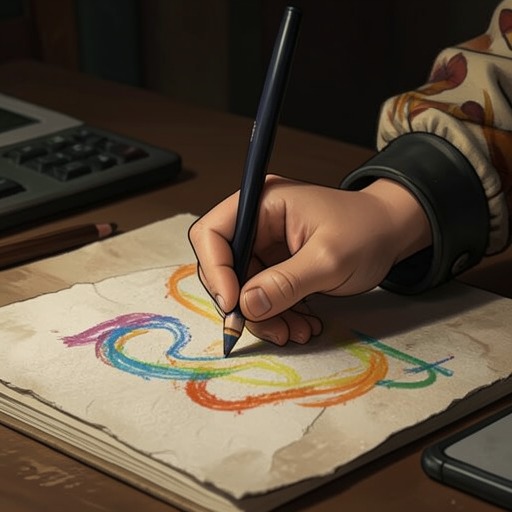
Imagination creates reality through drawing
Harold and the Purple CrayonImagination creates reality through drawing is the principle that organizes Harold’s journey: what Harold draws does not remain a picture or a plan but becomes an environment he must navigate and respond to. The purple crayon lets him supply what is missing, alter what is difficult, and invent ways forward. Yet creation does not guarantee control. The path fails to bring him where he expects, a Dragon frightens him, and an expanding search for windows leaves him unable to identify home. The story’s pattern is therefore both empowering and precarious: drawing gives imagination practical force, while the things it brings into being acquire consequences of their own.
From Need to Made World
Harold begins with absences. There is no Moon, although he wants to walk in moonlight, and he needs something to walk on. He answers these needs by drawing: the empty setting becomes a world that can support a journey. This opening makes invention a response to particular circumstances rather than an abstract display of creativity. A desired light and a usable surface are missing; drawing supplies what the walk requires.
The long, straight path is also meant to solve a problem before it occurs. Harold makes it so he will not get lost, and sets off carrying The purple crayon. The path thus embodies a plan as well as a place: its straightness promises order, and its stated purpose is to keep the walker oriented. But the promise is limited. Harold does not seem to be getting anywhere along it, so he leaves it for a shortcut. The contrast between the path’s intended usefulness and its failure to produce progress shows that an imagined solution can be real enough to act upon without being sufficient for its purpose.
Drawing as Navigation and Design
The shortcut leads to where Harold thinks a forest ought to be. Rather than enter an extensive wood where he might lose his way, he draws a very small forest containing just one tree. This is a distinctive use of imagination as environmental design: he does not merely accept a landscape as found, but scales it to meet the needs of the journey. His concern about getting lost shapes the forest’s size, just as the earlier concern about losing his way shaped the straightness of the path.
The tree introduces another kind of imagined possibility. Harold thinks its apples will be tasty once they turn red, and puts a frightening Dragon beneath it to guard them. The drawing gives the tree a prospective reward and adds a guardian to protect it. In these details, imagination does more than fill blank space: it arranges objects and relations, anticipating what the apples may become and assigning the Dragon a function. The imagined scene gains an internal logic, but that logic also creates a danger Harold did not intend for himself.
When Creation Exceeds Control
The Dragon frightens Harold. He backs away, and the hand holding The purple crayon shakes. That physical gesture matters because it connects an invented threat to an immediate change in his behavior: the created scene is no longer simply useful scenery but something he fears and retreats from. Drawing has furnished a danger with enough force to interrupt the journey, and Harold’s wavering hand makes visible that his control over the act of creation is not absolute.
Harold suddenly realizes what is happening, but by then he is over his head in an ocean. The sequence turns a moment of recognition into a crisis rather than an instant solution. The ocean is a dramatic contrast to the small forest and the single tree: the world he must contend with has become vast, and he is immersed in it. The episode establishes a recurring condition of the story’s imaginative process. Harold can make what he needs, but events may move faster than reflection; he must respond to the consequences of the world around him as well as shape that world.
His response is to come up thinking fast. That phrase marks a shift from composing a scene to improvising within a crisis. Later, the same practical connection between imagination and action appears when Harold wants a higher vantage point. He knows that the higher he climbs, the farther he can see, and decides to make the hill into a mountain. The enlarged landform is not an arbitrary embellishment: it answers a specific problem of orientation by increasing the height from which he hopes to look around. The episode extends the opening logic of the path, but with a different tool. First he makes a route to prevent getting lost; now he makes elevation to improve his view.
Invention as Escape and Search
When Harold falls, he keeps his wits and The purple crayon. He makes a balloon, grabs on to it, and makes a basket beneath it. In this sequence, drawing supplies not merely a place to stand or look from but a means of escape. The order of actions emphasizes its practical character: he creates the balloon, holds on, and adds a basket. The same instrument that earlier shaped a route and a threatening scene now helps him respond to a fall.
The aerial view does not solve the problem of finding home. Harold cannot see his window and cannot even see a house, so he makes a house with windows and lands the balloon on the grass. He continues by making more windows, then a big building full of windows, lots of buildings full of windows, and finally a whole city full of them. The growing scale of this search makes the difficulty sharper: increasing the number of possible windows does not reveal which one is his. His ability to produce a city’s worth of landmarks cannot, by itself, provide the personal knowledge needed to identify home. The repeated failure of the windows turns invention from a straightforward remedy into a demonstration of its limits.
Recognition and the Meaning of the Crayon
The search changes when Harold remembers where his bedroom window was when there was a Moon. He recalls that it was always right around the Moon. This memory supplies what the accumulating buildings could not: a stable relation between a familiar destination and a celestial landmark. Earlier, the Moon was something Harold needed for his walk; at the end of the search, it becomes a directional reference for finding his own window. The story thus returns to its opening image with a changed practical significance. A made world can provide routes, scenery, and escape, but getting home also depends on recognizing how its features relate.
Across these episodes, imagination is neither presented as limitless mastery nor reduced to daydreaming. Harold’s drawings organize action: he makes a path to avoid getting lost, limits a forest for the same reason, creates a Dragon to guard imagined apples, enlarges a hill to see farther, and makes a balloon when he falls. Each invention answers a circumstance, and each circumstance tests the invention in turn. The Dragon’s frightening presence and the fruitless multiplication of windows show that creation can complicate the problem it was meant to solve. The remembered position of the window provides the final correction: drawing gives Harold a world to move through, while recognition gives him the clue that lets him find his way within it.